Mao and Stalin were similar in the way they came into power and led. When Stalin came into power he took over in a storm but he was involved in the government already. When Mao came into power he was first a solidier. This was similar to Stalin. Also they were similar because they led the same way. They both were dictators and did not like to share power with the people. The people had no say in this government. So this is how they were similar.
Mao and Hitler were similar in the way they came to power and they way they led. Mao was similar to Hitler in one major way. They both set up reforms camps such as concentration camps or "re-education camps." Hitler set up these camps for the jews or the people who disagreed with the idea of communism. They were punished for what they thought because Hitler didn't like it. Mao was the same way. He set up these reform camps for people who didn't agree with what he was doing. Or if people said things wrong he would make them repeat them in public for humiliation. These are a few ways they are similar.
These are the signs of a dictatorship. When a leader wants to do things such as make decisions and such and not consult with the people then that makes you think that it is wandering away from a democracy. If a leader does not consult with his people when making decisions then that means that he is begining to think that a dictatorship is coming. Every time that a government turns into a dictatorship you always notice that the people either become afraid or they try to revolt against the idea of dictatorship.
Thursday, December 20, 2007

Tuesday, December 18, 2007
Local History Project
Brittany Sharpe
Mr. Viles
World Studies
December 18, 2007
Corinna Union Academy
The Corinna Union Academy is an old but well known building in Corinna, Maine. Everyday people may drive by this building and not know the history behind it. This building has a story and you will be learning about what it how it was built and what is has grown to be.
The Corinna Union Academy was built in 1851. This began when a group of 70 people came together to build this high school. Before this Academy was built there were not many schools in the town or the towns surrounding Corinna. If this Academy was built it would be one of the largest in the town. The idea that these people had was to create a school that the town could benefit from down the road and would educate fine students. 1 year later the school was licensed by the State and 7 years after that it opened. When the information on the courses and the school came out it read; the Academy contains 2 school rooms each one 32 feet. These were the drawing room and the recitation room. This means that there were 2 rooms in this old schoolhouse that were used for the education purpose. In 1931 the school was expanded. They built 2 more wings which had 4 classrooms. When this academy was built it was a 2 story white building with 17 windows and one door. It also included a bell tower. This is just what the town wanted. They had saved money for this Academy and now they had it. The style that this building was designed in is the Greek Revival style. These types of buildings were usually covered in clapboard and then were painted either white or gray. In this case the building was painted white. Also heavy trim is sometimes used and the corners of the building is accentuated by molding or carved wood. This type of building style was considered the first well liked and well used style of building.
Education then was much different than that of the world today. The first public school law was passed in 1647. This was started because the people of the towns wanted the children to have an education. This law had 2 purposes. The first was to stop Satans desire to keep men from the knowledge of the scripture. The other was to prevent learning from being “buried” or lost with those who came before their children. From these laws 1 person was appointed to teach these children all of the basic learning skills. Reading, Writing and Arithmetic. The wages for these teachers were paid for the parents of the children or the masters of the children. This law was the basis for the higher education standards and ideas. Schools were not plenty in the 1800s. In 1800 Maine there were 161 incorporated towns within Maine. Within these 161 towns were 7 grammar schools. These 7 schools taught about 100 families children every year. This meant that the classrooms would be cramped and the teachers would have a hard time keeping their class under control. In 1820 Maine had 236 incorporated towns and in those towns were 25 academies. During this time public taxation became the primary way of paying for these schools. Education now is much more different. Today there are 177 districts within the state of Maine with too many schools to count. Today we have programs such as no child left behind so that children get the education that they need. In those times they did not have these laws. This law ensures that every child gets a fair education that they understand and that they have a chance to do the best they can. In the 1850s there were no laws like this. Every child had a chance to learn but they did not have the tools or standards that we have today.
The Corinna Union Academy is now known as the Corinna Union Academy Historical Society. It was shut down as a high school in 1968 when Nokomis Regional High School was built in Newport, Maine. After this it became a junior high. It then was condemned as unsafe to for a junior high in 1998 and was shut down. It then caught on fire in 2000 in the upstairs and they had to replace it. Then it caught fire again in the tower. The damage was minimal and was fixed. In 2004 it was re-opened as a historical society. It still holds the meetings occasionally today. This building represents what the town has been through and how it changed. This school was in the town and it grew with the town. It is like a symbol of growth.
I hope that you learned a lot about this Academy and that next time you drive by you think what it has been through. It has been through fire and survived. It shows how the education has changed. It shows how much the times have changed from the architecture to the teaching styles. It also demonstrates how buildings can be used for many purposes. So next time you drive by and think what an old building, instead think what an amazing building.
Mr. Viles
World Studies
December 18, 2007
Corinna Union Academy
The Corinna Union Academy is an old but well known building in Corinna, Maine. Everyday people may drive by this building and not know the history behind it. This building has a story and you will be learning about what it how it was built and what is has grown to be.
The Corinna Union Academy was built in 1851. This began when a group of 70 people came together to build this high school. Before this Academy was built there were not many schools in the town or the towns surrounding Corinna. If this Academy was built it would be one of the largest in the town. The idea that these people had was to create a school that the town could benefit from down the road and would educate fine students. 1 year later the school was licensed by the State and 7 years after that it opened. When the information on the courses and the school came out it read; the Academy contains 2 school rooms each one 32 feet. These were the drawing room and the recitation room. This means that there were 2 rooms in this old schoolhouse that were used for the education purpose. In 1931 the school was expanded. They built 2 more wings which had 4 classrooms. When this academy was built it was a 2 story white building with 17 windows and one door. It also included a bell tower. This is just what the town wanted. They had saved money for this Academy and now they had it. The style that this building was designed in is the Greek Revival style. These types of buildings were usually covered in clapboard and then were painted either white or gray. In this case the building was painted white. Also heavy trim is sometimes used and the corners of the building is accentuated by molding or carved wood. This type of building style was considered the first well liked and well used style of building.
Education then was much different than that of the world today. The first public school law was passed in 1647. This was started because the people of the towns wanted the children to have an education. This law had 2 purposes. The first was to stop Satans desire to keep men from the knowledge of the scripture. The other was to prevent learning from being “buried” or lost with those who came before their children. From these laws 1 person was appointed to teach these children all of the basic learning skills. Reading, Writing and Arithmetic. The wages for these teachers were paid for the parents of the children or the masters of the children. This law was the basis for the higher education standards and ideas. Schools were not plenty in the 1800s. In 1800 Maine there were 161 incorporated towns within Maine. Within these 161 towns were 7 grammar schools. These 7 schools taught about 100 families children every year. This meant that the classrooms would be cramped and the teachers would have a hard time keeping their class under control. In 1820 Maine had 236 incorporated towns and in those towns were 25 academies. During this time public taxation became the primary way of paying for these schools. Education now is much more different. Today there are 177 districts within the state of Maine with too many schools to count. Today we have programs such as no child left behind so that children get the education that they need. In those times they did not have these laws. This law ensures that every child gets a fair education that they understand and that they have a chance to do the best they can. In the 1850s there were no laws like this. Every child had a chance to learn but they did not have the tools or standards that we have today.
The Corinna Union Academy is now known as the Corinna Union Academy Historical Society. It was shut down as a high school in 1968 when Nokomis Regional High School was built in Newport, Maine. After this it became a junior high. It then was condemned as unsafe to for a junior high in 1998 and was shut down. It then caught on fire in 2000 in the upstairs and they had to replace it. Then it caught fire again in the tower. The damage was minimal and was fixed. In 2004 it was re-opened as a historical society. It still holds the meetings occasionally today. This building represents what the town has been through and how it changed. This school was in the town and it grew with the town. It is like a symbol of growth.
I hope that you learned a lot about this Academy and that next time you drive by you think what it has been through. It has been through fire and survived. It shows how the education has changed. It shows how much the times have changed from the architecture to the teaching styles. It also demonstrates how buildings can be used for many purposes. So next time you drive by and think what an old building, instead think what an amazing building.
Wednesday, December 12, 2007
Exam #4 part 2
The opportunity for the Nazi's to come into power is simple. The leadership during the 1930's was not very good. So if someone came along offering people a reason for the terrible times and things that were happening. People were looking for answers as to why they were suffering and they were willing to do anything to make their life better. Germany was in a state of suffering. So if someone came along and offered them a new life and a better way to live it, the people would take that. That is why Germany was in an easy state for someone like Adolf Hitler to take over.
When Hitler first came forward telling people that the reason that the world was like this is because of the Jews people were spectacle. But when people are in desperate need for something else and someone comes along telling them that these Jewish people are the cause then they may start to believe it if they are told it enough. So Hitler began his journey to start a group called the Nazi's and start to persecute the Jewish people. Hitler began telling people in daily speeches that the Jewish were the reason that the Germans did have enough food or that the war was going on. So when the Germans were at their weakest Hitler began to form his group. He told people that he could help them get out of debt and get them money and a new life.
The German people did not rise against Hitler during the Holocaust period is because things were not bad for people who were not Jewish. They were not being persecuted or dying because Hitler was doing that to the Jewish. People were also afraid to rise up against him because of what he was doing to the Jews. If they tried to rise up against him he might do the same to them. Plus people figured that what he said was true. With the Jews in concentration camps there seems to be less debt and poverty and less problems. Even though this might not have been true and the Germans could see that Hitler told people this enough that they started to believe what he said was true. So instead of fighting back they let him be in control and handle a "problem" that was supposedly blamed on a group of innocent people. So this is why they did not rise up against Hitler because by the time he was done talking the German people weren't sure what he was saying was a lie because he had said it so much.
When Hitler first came forward telling people that the reason that the world was like this is because of the Jews people were spectacle. But when people are in desperate need for something else and someone comes along telling them that these Jewish people are the cause then they may start to believe it if they are told it enough. So Hitler began his journey to start a group called the Nazi's and start to persecute the Jewish people. Hitler began telling people in daily speeches that the Jewish were the reason that the Germans did have enough food or that the war was going on. So when the Germans were at their weakest Hitler began to form his group. He told people that he could help them get out of debt and get them money and a new life.
The German people did not rise against Hitler during the Holocaust period is because things were not bad for people who were not Jewish. They were not being persecuted or dying because Hitler was doing that to the Jewish. People were also afraid to rise up against him because of what he was doing to the Jews. If they tried to rise up against him he might do the same to them. Plus people figured that what he said was true. With the Jews in concentration camps there seems to be less debt and poverty and less problems. Even though this might not have been true and the Germans could see that Hitler told people this enough that they started to believe what he said was true. So instead of fighting back they let him be in control and handle a "problem" that was supposedly blamed on a group of innocent people. So this is why they did not rise up against Hitler because by the time he was done talking the German people weren't sure what he was saying was a lie because he had said it so much.
Exam #4 Part 1

Pablo Picasso's Guernica is a work of art not propaganda. Propaganda is the spread of information promoting some cause. This differs from art Art is the expression of what one is feeling or a way to let out what you are feeling after a certain event. This picture is not promoting a certain feeling or trying to make people feel a certain way. This picture is showing people what Picasso saw in the days those bombing occurred. If this picture was propaganda then there would be a clear statement trying to persuade someone of something. But you notice that there is no implication to say that the Germans are bad or saying that you should join the war. This is simply an expression of Picasso's emotions during this time.
In this image is shows bulls and horses falling and dying. This is just an example of how when Guernica was bombed there was no one who was spared on purpose. Then you noticed that there is a man who is laying on the ground with a broken sword. This is almost saying that these people in this place have been defeated. They cannot fight because they are so broken. Almost like the sword. But not only does this piece of art demonstrate devastation but also hope. If you look down near the bottom in the center there is a flower. Picasso included this because he wanted people to understand that there is still hope. That is why he included that because through all the devastation and commotion there is a tiny flower that symbolizes the life that will begin to grow.
This bombing was a tragic event in the war. This bombing occurred within 24 hours and totally wiped out the entire city. This bombing was significant because the Nazis were testing a new way of bombing that was called blanket bombing. They would fly over with planes and just drop bombs every 100 feet and this would hit very close on the ground and destroy people. This was also important because this made Italy very mad and they felt like they wanted to give up but they persevered because they didn't want people doing that to their country.
Thursday, November 15, 2007
Battle of Stalingrad
1.) Could not open this chapter
2.) Hitler reacted this way because when he signed the secret non aggression pact with Stalin, no one knew about it. But he also knew that Stalin would keep their promise of no attacks unless Hitler afflicted it on them. But Hitler wasn't a very trustworthy man so when he made this pact he had no intention of keeping this promise. This is why he said "I've got them!" because he knew that they would not attack him so he was safe and then he broke the pact and attacked them. He also wanted to prove that his army was the best and could not be defeated and he thought that this is what the pact proved.
3.) These posters show that propaganda was a big part of this war. These posters were telling the Soviet people that Hitler and his men were beasts and monsters. This demonstrates the fact that these posters were trying to tell the Soviet people what to think about these people coming in here to fight. They were also telling the people that these people that the Germans needed to be taken down and they were not good people.
4.) What the soldiers went through during this war demonstrates the fact that winning a total war takes a lot of supplies and courage to make it through. As the Russian winter began to set in the Germans saw how hard it was really going to be. As this chapter talked about the people becoming cannibalistic. The thing is that the German troops were not prepared or used to these kind of winters. Then they were taken out one by one by snipers whose will to win was great. So this just shows how hard it is to win a whole war and still have a lot of troops left over.
5.) This story relates to the war in Iraq because we tend to use a lot of snipers as do the Iraqis. This is relevant because I am sure that this is how the people who are snipers in this war feel. They must be patient and if they get one good shot it was worth it. The Iraqis who fight probably were taught to use a gun but they never thought that they would use it for that purpose. So Vasily Zaitsev was just like the rest of the Iraqis. They weren't trained to fight but when they did they did it well and fought well.
6.) Some heroic figures that emerged after the terrorist attacks of 9/11 were the New York City Firefighters. These firefighters took up the burden and risked their lives for the sake of saving other peoples lives. Some people died as did in the German and Soviet war. Some of the heroes died but they were still heroes. These firefighters were heroes because they took charge of search and rescue and they looked for survivors on their own time even if they were off duty. That is why they are heroes.
12.) Could not open this chapter
2.) Hitler reacted this way because when he signed the secret non aggression pact with Stalin, no one knew about it. But he also knew that Stalin would keep their promise of no attacks unless Hitler afflicted it on them. But Hitler wasn't a very trustworthy man so when he made this pact he had no intention of keeping this promise. This is why he said "I've got them!" because he knew that they would not attack him so he was safe and then he broke the pact and attacked them. He also wanted to prove that his army was the best and could not be defeated and he thought that this is what the pact proved.
3.) These posters show that propaganda was a big part of this war. These posters were telling the Soviet people that Hitler and his men were beasts and monsters. This demonstrates the fact that these posters were trying to tell the Soviet people what to think about these people coming in here to fight. They were also telling the people that these people that the Germans needed to be taken down and they were not good people.
4.) What the soldiers went through during this war demonstrates the fact that winning a total war takes a lot of supplies and courage to make it through. As the Russian winter began to set in the Germans saw how hard it was really going to be. As this chapter talked about the people becoming cannibalistic. The thing is that the German troops were not prepared or used to these kind of winters. Then they were taken out one by one by snipers whose will to win was great. So this just shows how hard it is to win a whole war and still have a lot of troops left over.
5.) This story relates to the war in Iraq because we tend to use a lot of snipers as do the Iraqis. This is relevant because I am sure that this is how the people who are snipers in this war feel. They must be patient and if they get one good shot it was worth it. The Iraqis who fight probably were taught to use a gun but they never thought that they would use it for that purpose. So Vasily Zaitsev was just like the rest of the Iraqis. They weren't trained to fight but when they did they did it well and fought well.
6.) Some heroic figures that emerged after the terrorist attacks of 9/11 were the New York City Firefighters. These firefighters took up the burden and risked their lives for the sake of saving other peoples lives. Some people died as did in the German and Soviet war. Some of the heroes died but they were still heroes. These firefighters were heroes because they took charge of search and rescue and they looked for survivors on their own time even if they were off duty. That is why they are heroes.
12.) Could not open this chapter
Friday, November 2, 2007
Book Portfolio
Book: Once there was a war
In the book Once there was a War John Steinbeck describes the horror and experiences that the soldiers in World War II went through. In one part of the book he describes the soldiers daily routine and what they told their officers when they went into battle. Usually at night the soldiers would eat and then shower. Sometimes they would gather in the mess hall to play cards or sometimes they would go and get their things ready. They always slept in uniform that way they were ready in the middle of the night if a battle was to break out. Steinbeck said that the soldiers never made their bed because when they came back from battle they wanted their bed to be ready and they could just jump right in and go to sleep without having to fuss with the sheets and everything. Also every morning when they got up and got ready to go to battle they would tell their officer in charge that if they died in battle that their ring and pictures were under their pillow. That is where all the sacred things went. The soldiers did not wear their wedding ring into battle because they knew that if they died then they would never get the ring. So they left it under their pillow for their loved ones to have if they died.
This book also talks about the fun that the soldiers had when they had time to have fun. They had a mascot that was a goat. They would always make sure they patted the goat before a battle for good luck. They said that if they could take the goat with them in the plane that they would. Steinbeck talked about one time how they got the goat drunk. There are no pleasures of war but when you ca have a little bit of fun, it takes the edge off.
In this book there was an amazing connection between the soldiers and you when you were reading it. You felt like you knew what they were going through although you really couldn't imagine it. When I read this book I began to have a greater respect for those who fought in this war and selfishly gave themselves up for the protection of other people.
In the book Once there was a War John Steinbeck describes the horror and experiences that the soldiers in World War II went through. In one part of the book he describes the soldiers daily routine and what they told their officers when they went into battle. Usually at night the soldiers would eat and then shower. Sometimes they would gather in the mess hall to play cards or sometimes they would go and get their things ready. They always slept in uniform that way they were ready in the middle of the night if a battle was to break out. Steinbeck said that the soldiers never made their bed because when they came back from battle they wanted their bed to be ready and they could just jump right in and go to sleep without having to fuss with the sheets and everything. Also every morning when they got up and got ready to go to battle they would tell their officer in charge that if they died in battle that their ring and pictures were under their pillow. That is where all the sacred things went. The soldiers did not wear their wedding ring into battle because they knew that if they died then they would never get the ring. So they left it under their pillow for their loved ones to have if they died.
This book also talks about the fun that the soldiers had when they had time to have fun. They had a mascot that was a goat. They would always make sure they patted the goat before a battle for good luck. They said that if they could take the goat with them in the plane that they would. Steinbeck talked about one time how they got the goat drunk. There are no pleasures of war but when you ca have a little bit of fun, it takes the edge off.
In this book there was an amazing connection between the soldiers and you when you were reading it. You felt like you knew what they were going through although you really couldn't imagine it. When I read this book I began to have a greater respect for those who fought in this war and selfishly gave themselves up for the protection of other people.
Friday, October 19, 2007
Exam #2
Mr. Viles Paragraph
The Colombian Exchange transformed the world in a more radical (thoroughgoing or extreme, esp. as regards change from accepted or traditional forms) way than any other development in world history. One significant effect of this process (a continuous action, operation, or series of changes taking place in a definite manner) was the establishment of the Triangle Trade. While many factors were a part of the Triangle Trade, the rapid growth in both supply and demand for new commodities was the largest motivating element. This time period may be best associated (to unite; combine)with economic developments, but it is impossible to analyze (to examine carefully and in detail so as to identify causes, key factors, possible results, etc.) this period without considering the intense social impact that the Triangle Trade had on those involved. In truth, a full understanding can only be gained by appreciating ( to value or regard highly) how economic and social factors (Ones that actively contributes to an accomplishment, result, or process) impact each other in history.
My Paragraph
The Colombian Exchange, which was trade of food products, animals and unknown diseases. American traded new food with Europe such as corn, tomatoes, pumpkins, squash and the sweet potato. The Europeans traded the Americans to cows, pigs, and grains also. America also received onions, fruits, sugar cane and coffee beans. These things were received from Africa and Europe. Diseases were also brought into America from all of the foreign trading. This exchange was one of the things that had the biggest effect on the development of the world. From this Triangle Trade was formed. Triangle Trade was a trade between Europe, Africa and the Americas. When this started there began to be a greater demand and need for more of the goods that were being traded. But then there became a greater supply because there was more of a need. Things such as cotton, ammunition, weapons, sugar, fruit and meat became popular in the trade. The rapid and constant needs for these things was a driving force for the Triangle Trade. This time period can only be remembered for its economical developments but we cannot forget the social developments that took place due to Triangle Trade. The only way we can really take a closer look into this time period is to first understand and appreciate how social and economical developments tie into each other and have effects on the outcome of society.
The Colombian Exchange, which was trade of food products, animals and unknown diseases. American traded new food with Europe such as corn, tomatoes, pumpkins, squash and the sweet potato. The Europeans traded the Americans to cows, pigs, and grains also. America also received onions, fruits, sugar cane and coffee beans. These things were received from Africa and Europe. Diseases were also brought into America from all of the foreign trading. This exchange was one of the things that had the biggest effect on the development of the world. From this Triangle Trade was formed. Triangle Trade was a trade between Europe, Africa and the Americas. When this started there began to be a greater demand and need for more of the goods that were being traded. But then there became a greater supply because there was more of a need. Things such as cotton, ammunition, weapons, sugar, fruit and meat became popular in the trade. The rapid and constant needs for these things was a driving force for the Triangle Trade. This time period can only be remembered for its economical developments but we cannot forget the social developments that took place due to Triangle Trade. The only way we can really take a closer look into this time period is to first understand and appreciate how social and economical developments tie into each other and have effects on the outcome of society.
Wednesday, October 3, 2007
Slavery Project
Slavery in the Caribbean Islands: Jamaica, Barbados and Cuba
The places where slavery was the worst in the Caribbean was in the places that the French and English Empire had already taken over. By the end of the 17th century the rate of slavery went up because the production switched from tobacco to sugar. When people farmed sugar it took more slaves to harvest it that it did tobacco. The high demand for sugar in Britain caused the need to raise more sugar in the Caribbean greater. As the demand got higher the need for more slaves and harder work increased. But the slave trade didn't just leave a greater need for slaves but also a need for people who knew how to build ships. When the slaves were transported the need for ships increased because when the slaves were taken over to the places they were designated for they used quite a few ships because they were trading all the time and they were always using ships either for transporting slaves or for the use of trade of goods. When the shortage of ships presented itself then there became a greater need for people to work in the ship yards and build more ships for the use of slave trade.
Jamaica and Saint Domingue became 2 of the islands that were more brutal to slaves. Most of the people that they enslaved where black and during that period the death rate was higher than the birth rate. The birth rate dropped 3% in Jamaica .This indicates that more people were being killed than being born. This could also have been done as a form of resistance. Mothers did not see the point of having children if they were going to be used as slaves so they did not reproduce as a way to punish their masters. In other ways the slaves would sing songs to insult their masters and then pretend to be ignorant to avoid the punishment. Most death was caused by malnutrition and overworking the slaves. These slaves were worked from sun up to sun down. These slaves had been imported from Africa and there were so many that 85% of the population was slaves. A lot of these slaves either tried to rebel or they succeeded. This included self mutilation, suicide and escape. The slaves that did escape often started there own colonies. These slaves were usually taught English so that they could understand their masters but it was forbidden for them to speak that language when the day was over.
Jamaica and Saint Domingue became 2 of the islands that were more brutal to slaves. Most of the people that they enslaved where black and during that period the death rate was higher than the birth rate. The birth rate dropped 3% in Jamaica .This indicates that more people were being killed than being born. This could also have been done as a form of resistance. Mothers did not see the point of having children if they were going to be used as slaves so they did not reproduce as a way to punish their masters. In other ways the slaves would sing songs to insult their masters and then pretend to be ignorant to avoid the punishment. Most death was caused by malnutrition and overworking the slaves. These slaves were worked from sun up to sun down. These slaves had been imported from Africa and there were so many that 85% of the population was slaves. A lot of these slaves either tried to rebel or they succeeded. This included self mutilation, suicide and escape. The slaves that did escape often started there own colonies. These slaves were usually taught English so that they could understand their masters but it was forbidden for them to speak that language when the day was over.
Triangle trade was a form of slave trade but it involved more than one continent. It began in the seventeenth century. A ship would leave Europe and head for Africa around the Gulf of Guinea. Once they reached their destination in Africa they would trade weapons, ammunition, copper, liquor, cloth and pots for either captives from raids and wars or slaves that they had no use for but were in good condition. Then the ship would travel to Cuba, Jamaica and Barbados and trade the slaves for things such as sugar, rum, rice, coffee, tobacco and cotton. Then they would return back to Europe with these goods. If you were to look at this on a map it would look at a triangle hence the name "Triangle Trade". These trades can also be known as the "Transatlantic Slave Trade".
Between 1540 and 1850 it is estimated that more than 11-12 million people were transported on slave ships. These ships were very unhealthy and did not leave most of the slaves in good conditions. An average slave ship was made to hold about 440-450 slaves but many times held more than 600 slaves. These slaves were chained together at their hands and feet with things known as leg irons. These leg irons were not completely round so they did not fit around the ankle comfortably. The picture below is an example of way leg irons looked like. These leg irons are individual but the ones used for the slaves had at least 4 to 5 sets on one chain allowing people to be grouped when loaded.
These slaves were piled in the ship like sardines. When the slaves entered the ships they were put in a certain area. Then the would have to lay down on their backs as flat as they could and lay as still as they could. But the way they were placed in the ship there was not much room to move anyway. This is an example of how the slaves may be arranged in a slave ship.
So in conclusion you can see that during this time period people had it rough. The slaves were dying faster than slave women were having kids. Some thought that this was a way of revolting. These slaves were getting sick from the ride to the Caribbean Islands and they could not be cured. This was a difficult time for everyone and when it ended around 1850. This was monumental but there was still some slave trade in Jamaica. But all in all when this slave trade stopped, the world in that area got better.
Wednesday, September 26, 2007
Exam #1 Essay Question
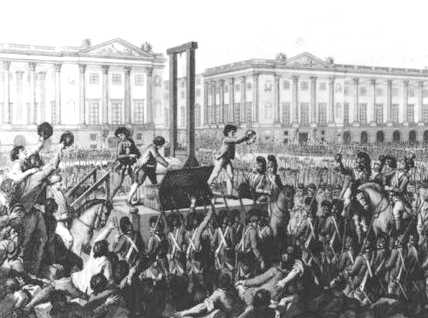
In this picture King Louis XVI is being executed. This picture gives you an idea that no one was safe when it came to the guillotine and being executed. If the people wanted to overthrow you and kill you they would try and usually succeed. This also shows a person holding up King Louis XVI head and all the crowd rejoicing. This says that the people were sick of the king and were glad to see him go. The man is holding up the king's head as if to say "Here is the man you once called king. He was weak, we overthrew him." Basically what this picture shows is that during this period the people were in rule. The king could try to keep them under control but the people and the mobs dominated. This also shows soldiers around the guillotine. It basically shows that no one dared to try to calm down the mob and stop them from doing this to people. Even the soldiers who were supposed to be loyal to their king stood guard and did nothing while their king was murdered. This is a perfect example of how badly things were out of control.
 This photo is showing the Fall of the Bastille. The Bastille was a huge prison that was suspected to torture their prisoners. In this photo you can see that the common people are helping knock down the prison. Some of the people who are running the cannons aimed at the Bastille are commoners who have joined in the downfall. This proves that the people were so fed up with the king that they would join in to try to knock down one of the biggest buildings in the city. This photo also shows some of the people on the ground shooting at the building on the right. This demonstrates how the people and soldiers of the town were not putting up with any problems with anyone. They were taking matters into their own hands and they were not afraid to shoot people of their own. In this picture you also notice how large the building is. You can see that the people have not gotten very much of the Bastille to fall. This demonstrates the determination of the people to prove a point that they need to be heard. They obviously put a lot of effort into getting the Bastille to fall which demonstrates that nothing is going to stop these people.
In conclusion these photos give a peek at the big picture of the French Revolution. The people were hard workers and they had great determination. Nothing was going to stop them and they were a force to be reckoned with. They had no fear of great obstacles and they would deal with them when they came. These photos also show that the people were tough and they would not let a minor obstacle or obstruction stand in their way. Basically the people got what they wanted when they wanted it and if anyone was going to stop them they had to be strong. These people were looking for any way for the violence and madness to stop. If it meant killing the king then they were going to do it if it gave them any hope of freedom and peace.
Monday, September 24, 2007
Thursday, September 13, 2007
Thursday, September 6, 2007
First Post
This is my very first post using my Google Blogger. I am in Mr. Viles class this year. I think that I an going to learn a lot this year. I kinda like the idea of using the computer all the time. But sometimes I can be very computer ignorant. I am a little uncomfortable about using computers all the time.
Subscribe to:
Posts (Atom)