Monday, October 20, 2008

I read the book A Year Without "Made ...

                                                                                                                                                                         October 20, 2008

                                                                                                                                                                                     Period 1


A Year Without "Made In China"


      I read the book A Year Without "Made In China" by Sara Bongiorni. The major theme that kept coming up is that America is really dependent on China. But it is not just Americans it is everyone. We depend on China too much and they are becoming manufacturing capital of the world. This theme just shows that America was once independent but as time goes on we have become more and more dependent. Sara Bongiorni basically showed us that it is hard to live normally and not buy stuff from China. It shows our level of dependence on China and how hard it would be if America stopped buying things from China.

       America has become so dependent on China that if we were not able to buy things from China, it would be hard because so much of what we use is Made In China. One example from this book is when Kevin wants to make Wes a toy car he realizes that it is going to be harder than he had anticipated. He finds that the wheels are all made in China, he has to pay 5 dollars for a Brazilian made dowel when he could have paid 1 dollar for a Chinese made one. This is the first struggle. Another one is when Sara wants to buy a Barbie doll for her daughter. She finds that all of the dolls are made in China except for one, which is made in Indonesia. Most every little girl plays with Barbie dolls. Just think if China stopped making them. We would be left with nothing except for a few from Indonesia. Most things such as film and toothbrushes look identical but there is one difference. One is made in China and one is made in the USA. Sometimes no one realizes whether what they are buying is American or Chinese. This is because most of what is made looks that same and could probably just be manufactured in America but it is not. This theme is significant in the book because these people vowed to stop using made in China products and they realize just how much is really made in China.

        This theme is history is very significant. When we signed the Declaration of Independence we signed it to gain independence from the British Empire. When we buy things from China we are kind of going back to before we signed the Declaration. We are depending on China to supply oiur goods to sell so that we can make money. But first we pay China to make things and then we put them on our shelves and ignore the fact that we didn't make it. We have reverted back to our old ways. We need to become dependent from China because what would happen if China stopped selling goods to us. We would experience a massive drop in sales.

        The perspective of this book is a personal perspective. Sara Bongiorni tells her story of trying to avoid buying things from China. She had to change her lifestyle and basically how she adapted to buying things from America and other countries. This relates to the theme very well because she realized that her way of shopping and such changed. She realized how much the USA dependended on China. This perspective is significant because she is a normal person just like us and when we read this book told from a normal person experiencing what we would go through. This perspective is very important because of this.

        In conclusion, the big theme in the book and in history is that America is dependent on China. We worked for independence when we signed the declaration and now we are back to being dependent on a country. The point that this story is told by a regular person really is good because we can connect to what she is saying. This theme is very important and should be kept in mind daily because of people that died for us to be free but we are not totally because of the goods that are shipped in from China.

Thursday, June 12, 2008

Final Essay #2

As a country we have had our shares of ups and downs. Most of these "ups and downs" are "solved" with war. It seems that in every country that you go to the solution to a problem is war. If someone disagrees with some other countries government then there must be war to try and change one or the others government. But as some have learned, war is not the answer. In the French and Indian war, there could have been a settlement between the two. Also in King Phillip's War, the bloodiest war of them all, there could have been a more peaceful solution. Most of the wars that take place are unnecessary. There could have been a better answer to a problem but some leaders are too lazy to take the time to figure it out.
Here are a list of wars that have taken place; King Phillip's War, French and Indian War also known as the Seven Years War, Pontiac's Rebellion and the American Revolution. All these battles could have been prevented but no one took the time to analyze the situation and really think about different solutions. These wars are all examples of where human greed and nationalism took over. People love their country and that is great. But no one needs to go to war with another just to determine who is the better. It is like the saying "anything you can do I can do better." This saying is a perfect example of the thinking that some people have. If one country or group of people do something then another group must try to outdo the other. This mentality is not a good way of thinking and causes may problems.
The War in Iraq is definetly a war of human greed and trying to play hero. On 9/11 terrorists attack us and it did break us down. But there could have been a different solution. We have now been across for 5 years and there could have been a different solution for all the fightint. We have killed innocent people that have had nothing to do with the problem that occured. There could have been a different solution. We could have come to a settlement. We caught Saddam Hussein and that was good. But we could have found another way to find him instead of blowing up buildings that we have to rebuild and killing people who are innocent. So basically I think that there is always a different solution to any problem than war.

Final Essay #1

We have had many great leaders in this country. But the most significant one that we think is our first president, George Washington. He was devoted to this country as soon as he joined the army as a scout at the age of 21. This shows a dedication and love for a country that would eventually lead to him leading us in many of the great battles of our time. Although he struggled in some battles such as the Battle of Brooklyn Heights. This was not a good battle to have fought at all. But he still prevailed and learned from it. There was also Valley Forge. This was one of the toughest winter that the troops had probably ever experienced but they were commanded by General Washington so they recovered and were ready to fight and end the war.
George also fought in the French and Indian War. This was going to be a learning experience for him. He was brought up in England and the way that they "organized war was different. England had troop standings. There were ranks such as general or colonel. Indians did not have this kind of organization. The Indians were not trained in military tactics and they knew nothing of having ranks or troop standings. Their idea of fighting in a war was something like hide and seek. The Indians knew the land that they were fighting on so they had the upper hand. They could hide and then, when the French came to fight them, the Indians could pop out and shoot them. This was new to George Washington. Washington first became involved in this war when the Governor asked him to take a letter to the General a letter warning him to move his troops from the site they were at because it was time to change forts. This was a learning process for George because in order to deliver the letter he had to think like the Indians or else they would outsmart him and he would be a captive. So this was one way the Washington was versatile. He could learn new tactics specific to the situation that he was in. This is the sign of a good leader and a good soldier.
He also had a big part in the American Revolution. As a General in the Continental Army there is a lot of pressure to win battles. If you do not win a battle and your opponent does, then they have one up on you. A perfect example of this is the Battle of Brooklyn Heights. As this was fought on a peninsula George thought that if he stationed his men at the tip and around the he could prevent them from getting to land. This was just the opposite though. He was wrong and the British came in from land and pushed them off the peninsula. This was thought to be the end of the war for George Washington because the British thought that they were going to ambush Washington and end it there. But Washington outsmarted them and got away. This was the start to a great chase for Washington and his soldiers. This battle shows that he sometimes does not think the situation out thoroughly. Had he thought about the different ways that his plan could have failed he should have changed it so that he could have had more of an advantage. This is one flaw that is shown. But also is shows a determination to win. He was not going to just give up and let them beat him. Another way that his good leadership is shown is at Valley Forge. Although this was one of the hardest winters that the troops had ever seen they did not give up. Washington helped them through it and it became an experience to learn from.
These are just a few of the reasons that this great man became our founding father. He first began as a 21 year old scout that was sent to try to come up with an agreement between French and British. He later was chosen to warn the french during the French and Indian War. Then he evolved into a General. He led troops into battle and succeeded in fighting off the enemy. Sometimes this was proved as false but he did not let that get him down. He picked himself back up and began to fight again. He did not get discouraged and he continued to grow and learn. This is the sign of a true leader. This is also why he is our founding father and the reason America was started in such a positive way.

Tuesday, May 20, 2008

Book Portfolio #4

Animal Farm By George Orwell
This book is all about "animalism" which is based on socialism in the time of Stalin. It all starts with a pigs dream to take over the farm. He dies, but his ideas and dreams of the farm being run by animals continues. The more the animals strive to reach this goal, the more power hungry they become and they will stop at nothing.The theme in this book is that the idealists from the Soviet Union were corrupting and they would stop at nothing. Stalin and his followers can be compared to Old Major and Napoleon. The rest of the animals are his followers and whatever he says to do they must do. This theme is significant because it shows the ideas of the Soviet Union in a different light. It shows what the conditions were like when people refused to follow or if they were becoming old and useless. They would sell them, even if it was their best friend. That meant nothing. All that matter was that the socialist ideas prevailed.

Socialism must succeed no matter what and it changes people for the worst. This is the overwhelming thought in this book. The first example of this is when the animals scare away Mr. Jones, the farmer. This demonstrates the theme because this is the first action that they took in their fight to take over. This shows that they were ready and were not going to let anything stop them. They wanted to carry out the plans the Old Major never got to because of his death. The second example is when Snowball is chased away from the farm by Napoleon and his puppies that he was "educating." He then took command and stated that there would be no more meetings. The only ones to make decisions would be the pigs. This showed the fact that all animals were not equal and it began to show who would be the power hungry ones. Napoleon then decided to purge the farm of anyone that may be followers of Snowball. He doesn't want anyone who does not follow him wholeheartedly. So he looks for the ones who are not loyal and they are killed. The last example of the theme is the fact that Napoleon sold his friend who was sick just for money to get whiskey. This shows that the leaders would not even let their feelings get in the way of furthering themselves in the socialist or "animialist" community.

This theme can be shown in many historical contexts. The most obvious one is the Russian Revolution. With Stalin and his men taking over and installing the socialist beliefs in people. The other historical event this could be tied with is the Holocaust and Hitler. In the book Napoleon started making things up about Snowball that weren't true. He told people that he was bad and that he was the one who destroyed the windmill. He then went on a hunt to find everyone on the farm that supported Snowball. They were then killed. This is similar to what Hitler did to the Jews. He blamed them for the War that had happened and everything else in the world that they lived in. He then began to "purge" the world of the Jews. He began to tell people that they were to blame for everything and that they deserved to die. This is what Napoleon did to Snowball. It can also be connected to Stalin and his way of living. Stalin was a socialist and he believed that there were certain people that deserved to be in power. He also thought that if you were going to succeed nothing could stop you. Not friendship or anything. In history Stalin started out as a secretary general of the communist party. This is similar to Old Major and Napoleon. They were first part of the group who were loyal to the humans. They gratefully served them. But then they turned on them and decided to take over. This is similar to Stalin because he manipulated people to let him be the only one in power. He then decided that he didn't like the Communist party and wanted to get rid of them. So he captured whoever belonged to that party and either they died in prison or they were killed. The last connection between this book and Stalin was that fact that he stopped at nothing. He was willing to kill the people that he knew and were possibly friends with just to get what he wanted. He wanted to be a part of socialism and nothing anyone could do was going to stop that. This theme is significant in history because Stalin and Hitler were 2 of the most powerful people in this time as were the pigs on the farm. We need to learn about our past to realize how we got to where we are today and this was a big part of it.

So in the end the hunger for power in the socialist or "animalist" community overtook everyone and they were not the same. They got what they wanted no matter who they hurt in the process. The importance of this theme in the book is because it seemed to be based on true events and you need to understand what happened. The importance of this theme in history is because the socialist way of life was not a good one. This has been demonstrated by many people in history including Hitler and Stalin. This book was very effective in showing the theme. It had very good examples and real life connections. I also thought that it was very interesting and it keep you asking questions and wanting to read more. In the end of the book it was said that "All animals are equal, but some animals are more equal than others." This is very true even in our society today. We all are "equal" but it seems that some can get away with more. It is also said in the end that the other animals could no longer recognize who were pigs and who were humans because they all looked like pigs, greedy and ruthless and will stop at nothing.

Friday, May 16, 2008

Valley Forge Letter

February 12, 1778

Dearest Elizabeth,
I am sorry that I haven't written sooner. I hope I have not caused you to worry. How are you? I hope that you are well. How is our new daughter? She has been the constant thought on my mind ever since I received your letter. I miss you terribly and the thought of coming home to you is what is keeping me alive.
The Georgia weather is nothing like what I have experienced here. The rain is colder and seems to fall on me like bad memories. The first few weeks of camp was hard because we had to sleep on the ground. When it snowed, which it did often, we had to tuck our guns between our legs so that the powder did not get wet. We had nothing but our jackets and had no blankets or shelter. I wish I had brought one of those wonderful homemade quilts that you make so well. But there is good news. We now have huts that 12 men have to share. These are not clean and they do not keep out the draft, but it is better than sleeping in the snow.
But the weather is not our main concern. Sickness has been looming over our heads and we cannot seem to beat it. Dysentery and typhus are the diseases that are our enemies now. Dr. Boto Otto opened a hospital 10 miles away from camp. The sickest of our men are taken there but most times we cannot afford the trip. It is too far of a journey with the conditions being as they are.
When I enlisted, I was honored by the fact that I would be protecting the colonies I lived in. But now I want to come home. People are getting tired. We do not have supplies because Gen. Thomas Mifflin has not been doing his job. He did not organize supplies to be brought in. But Gen. Nathanel Greene is in charge of that now and things are beginning to look up as much as they can. He has been repairing roads and we even now have a bakery thanks to him. This has boosted moral but we still are broken from all the ground and battles that we have lost. I think that from this experience, I will not enlist again.
Well my love, I must depart from you now. I have many duties that need to be done. Tell my family that I miss them and think of them often. Tell our sweet little girl that daddy loves her and give her a kiss for me. I will be home soon. You have all of my love.
Yours forever,
Daniel


Thursday, May 8, 2008

Essay #2

As colonists we must stand up for ourselves. We must be able to defend our colonies and be sure that we are in a good position to protect ourselves. When we moved to this land we were sure that we would have a better life so we must strive to obtain that goal. As a group of colonies if anyone tries to hinder our growth then we must do something about it. Since trying to work this out is not going to work. We must fight. We must defend what is rightfully ours! Why let them control us when we are the ones that have built up this colony and established a name for ourselves? We must break down this wall that is holding us back. Britain must know that we are not a force to be reckoned with. They must be defeated!!!
There are many reasons that the British need to be taken down. The first is the taxation. Why must they tax us on everything. It is becoming harder and harder to live. They are taxing sugar which we use in everyday life. They are also taxing molasses and also paper. Why are they doing this. They feel the need to control how we live. Why should we allow them this? When we can no longer pay the taxes that they are putting on everything, how will we survive? We cannot live on bread and water very long. We are hungry for freedom! We must seize this opportunity now while we can. Men do you want your children to grow up in a world where you must pay a tax on everything? Do you want them to have to sell their house because they cannot survive? NO, we must not live like that!
Right now our future is looking grim. We will be living in the shadow of British forever. We, as a whole, must stand up and be in charge of our future. We must take over to make sure that what we want to happen will happen. America could be a beautiful, free country. We are stronger than people think and we must demonstrate that. We as an America can lead our own country, we can take charge and make things happen. This is why we must show the world what we can do. We must fight Britain and show them that we are a force to be reckoned with.

Essay #1

Although it was a tragic event the Boston Massacre was the fault of the soldiers . The British soldiers should not have shot into a group of people that were out of control. They should have been able to control them other than having to shoot them. When the shot was fired and the rest of the British soldiers took that as an invitation to fire on everyone, including young boys. That behavior cannot be condoned.
The British soldiers are to blame for this terrible event. Although the people were getting a little excited but the British should have been able to control the people. They shouldn't have had to fire shots and kill innocent people. This act that was committed showed the heartless, and brutality of the British soldiers. They did not think twice about shooting into a crowd of people that included grandfathers, fathers, brothers and sons.
These soldiers that committed this awful crime should be put in jail for at least 2 years. We cannot let the act of killing people slide. They must pay for the actions that they committed. I feel that although the people should not have been in the square at that time, the british should not have shot into the crowd. The king must punish people for the crimes that they commit or else everyone will start to try illegal things. So these acts must be punished.

Wednesday, April 30, 2008

Henry Knox

Person: Henry Knox

Born in Boston, Massachusetts on July 25, 1750. He was the Major General in the Continentinal Army and he later became the Secretary of War.

He first became involoved in government and war in 1772. He joined the Boston Grenadier Corps, he supported the Sons of Liberty and he was present at the Boston Massacre. The Sons of Liberty included Paul Revere, Joseph Warren, John Adams, Sam Adams and John Hancock. He joined the war when he was 18 and was eventually promoted to Major General in the Continental Army. He also was the chief artillary officer. He served under General Artemas Ward in the Battle of Bunker Hill. In 1775 George Washington took over and Henry Knox caught his eye. Washington and Knox began to form a relationship with each other. They started to become good friends. Washington would go to Knox for advice and later he became the chief artillary officer. Knox was left in charge of the placement of cannons and he helped secure the defenses. Knox laid seige on Boston in May of 1775. He also helped in the Battle Of Brooklyn Heights where they were battling General Cornwallis who was under the charge of Lieutentant General Sir William Howe. Knox was then promoted to Commander-In-Chief.

During the winter of 1777 he was in charge of raising a batallion and creating an arsenal. He was then almost outed from his position of chief or artillary by a man named Ducondray who was supported by Silas Deane. He tried to take over Knoxs' job but General Washington repsected Knox enough to let Knox keep his job. Washington, Knox and Nathaniel Greene were the only generals to serve in all 8 years of the war. Knox also served in the Battles of Princeton, Brandywine, Germantown, Monmouth and Yorktown. In June 1784 he retired from being an officer in the continental army. In 1789 he then became the Secretary of in War in Washington's first cabinet. Thomas Jefferson was the Sercretary of State, Alexander Hamilton was the Secretary of Treasury and Edmund Randolph was the Attorney General. In 1795 Henry Knox resigned from the cabinet and retired to his home in Thomaston, Maine and died in October 25, 1806 from an intestinal infection.

Henry Knox joined the army because of his love for the country. He also dropped out of school and became the only one supporting his mother. He then opened a bookstore but later decided that he wanted to join the war.

Henry Knox does deserve a lot more recognition. He was the right hand man of George Washington. He helped him make decisions that influenced the way that our country is today. Henry Knox has 2 American Forts decicated to him. Fort Knox in Kentucky and Fort Knox in Maine. This is good but he deserves to have more credit. He fought and made influenctial decisions that were key to Washington winning the ground that he did. He was the chief artillary officer and helped trained people to run the cannons and the guns. He was a Commander-in-Chief in the Continental Army. He was a great leader and his word was very powerful in the time that he lived. If you ask most people who Henry Knox is, they will not even know who he is. This is sad because he was one of the only Generals to serve all 8 years in the war. This alone deserves recoginiton because it shows his dedication and love for his country. So in the end Henry Knox deserves much more recognition than he has right now.


http://www.newworldencyclopedia.org/entry/Henry_Knox
REWRITE THIS INFO
He weighed more than 300 pounds, as did his somewhat intimidating wife; in New York they were commonly known as the "largest couple in the city."

Tuesday, April 1, 2008

Quarter 4 Notes

Revolution and War
1763-1789
Revolution Notes
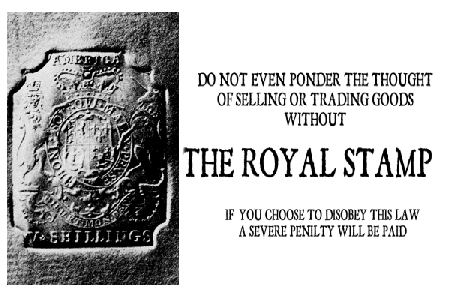
1763—Proclamation Act-

King set aside land for the Indians around the Appalachian Mt's. No colonists were allowed

1764—Grenville Acts
Direct tax of things such as sugar, molasses and wine
Sugar (molasses, wine)
Stamp
Quartering
Currency
Direct Representation


1765—Stamp Act Congress

A group of people from 9 colonies that tried to end tax for the colonies
Sons of Liberty
A group of people who got together to intimidate people into doing or not doing things. Such as forcing Stamp Distributors in the colonies to resign.
Samuel Adams
Paul Revere
John Hancock
Propaganda
Boycotts
Lobsters (Lobster-backs, Thomas Lobster)

1766—Declaratory Act-
Took back Grenville Acts but really still had them but they weren't declared.

1767—Townsend Acts (indirect tax)
New taxes were issued on paper, paint, glass and tea. They then said that there was to be no British goods sold in America. 2nd attempt to tax the colonies.
Charles Townsend
Writs of Assistance (search warrants)
Revenue used to pay Royal officials in the colonies
Tea Act (glass, paper, paint) support British East India Company

1770—Boston Massacre
The first bloodshed between British and America. A mob was taunting a solidier and then a soldier fired into the crowd. 10 hit and 5 dead. Propaganda!!-Paul Revere
March 5, 1770
Local reaction (primarily)
5 dead colonists
John Adams defends British soldiers/5 exonerated-2 convicted
Convicted men discharged and thumbs branded


1773—Boston Tea Party
Tried to tax tea.East India Company was selling it cheap. Trade would be affected. Tea was then thrown overboard.
November 30, 1773--Dartmouth sails into Boston Harbor
December 16, 1773--Tea dumped into harbor
340 chests of tea dumped (value of 10,000 British pounds)

1774—Intolerable Acts (Coercive Acts in Britain)
Colonial Authorites should supply a barracks and supplies. Port of Boston closed until damaged from Boston Tea Party was paid for. British officials could not be tried in any courts other than in britain. Governor also ran meetings.
Close the port of Boston
Shut down Provincial and Town Governments
All offices appointed
Named General Thomas Gage as Governor
Gave all western lands north of the Ohio R. to Quebec, allowed Catholic Church to practice.


1774—1st Continental Congress
Representatives from all colonies except from Georgia gathered to discuss the Intolerable acts and Britain.
September to October (7 weeks)
Carpenter’s Hall, Philadelphia
New England—John Adams, Paul Revere, Silas Deane
Virginia—Washington, Patrick Henry, Peyton Randolph, Richard Henry Lee
Pennsylvania—John Dickenson, Joseph Galloway (Plan for American council under Parliament, to avoid war)
New York—John Jay, James Duane
Maryland—Samuel Chase (future Supreme Court Justice), Charles Carroll (richest man in Maryland, Catholic)
Declaration of Rights—rejects Parliamentary authority over internal colonial affairs, colonies manage own defense, united aid to Boston if Intolerable Acts continue, absolute boycott of British goods to be enforced rigidly

1775— January
William Pitt tries to suggest to pull troops from America
William Pitt urges Parliament to withdraw troops from America because the idea of managing the colonies through force was “too ridiculous to take up a moment of your lordships’ time”

1775—April 19 Lexington and Concord
First shots that were fired to start the revolution. Paul Revere was captured during this battle as a messenger.
Gen. Gage sends 700 men to Concord to seize the powder supplies
Paul Revere and William Dawes raise alarm the night before
Town of Lexington is on the way to Concord
Minutemen are assembled on the town common
“Shot heard round the world”
18 colonials killed and the rest run away
British march on to Concord and find the munitions were moved overnight
Minutemen ambush the British the whole way back to Boston
430 Redcoats make it back to Boston
30,000 Colonists surround Boston

1775—May
Fort Ticonderoga was captured.
Gen. Howe, Gen. Clinton, Gen. Burgoyne
5,000 British troops
Ethan Allen, “Green Mountain Boys” seize Fort Ticonderoga
Henry Knox uses canon to lay siege on Boston
Benedict Arnold (Connecticut) takes Fort Crown Point to impede an invasion from Canada

1775—May 10, 2nd Continental Congress
Members of the 2nd continental congress met in Philadelphia.
Sam Adams pushes for Independence
John Dickenson (Penn.) urges restraint
Agree to form Colonial Army
Delegates unanimously agree to Washington as Commander of Continental Army (John Adams suggestion)

1775—June 17, “Battle of Bunker Hill”
Gen. Howe led this battle. The soldiers came in waves. They were sent up the hill and were not heavily stocked on ammunition. The British had more losses but is considered to have won because they got the ground.
Actually fought on Breed’s Hill
Gen. Howe leads assault without canon support (his canon had been matched with wrong-sized cannonballs [Amherst at Ticonderoga])
Militia waited to within 30 yards (some say 15 yards)
Militia target British officers
Militia ran extremely low on ammunition
On the third assault, led by Gen. Howe, British troops overtake the colonial position
Britain losses almost 1000 men (about half the attacking force)
Colonials lose about 500 men

1776—January, Common Sense-
Wrote to inform the common people. Was often putting down the Hierarchy.
Common Sense by Thomas Paine
2,000 copies sold in three months


1776—March
Gen. William Howe evacuates Boston
July 2, lands in Staten Island, New York (Loyalist base)

1776—Declaration of Independence
Declared the 13 colonies independent from England
June 7, Richard Henry Lee (Virginia) introduces legislation to declare independence from Britain
Before voting on Lee’s proposal Congress appoints five-man committee to draft a formal Declaration of Independence (Thomas Jefferson, 33, does most of the writing)
June 28, Declaration presented to Congress
July 2, Congress approves Lee’s legislation to declare the United States of America independent of Great Britain
July 4, Congress officially adopts the Declaration of Independence
The Declaration intended to:
Undermine loyalty to King George III
Outline basic principles of representative government
Establish the “right” of rebellion


War

1776—August, Brooklyn Heights, New York
Washington thought that he was going to win because he was on the peninsula. Was wrong and this is when the running began.
Largest Naval group Britain will launch until the 20th century
British victory, city falls to England
As winter came “sunshine patriots” left the American Army
Initial colonial enlistments due to expire

1776—December, Battle of Trenton
Washington plan sneak attack on the Hessian camp. Crosses the Delaware amd captured 918 hessians. First Big Victory for Washington
Howe believes war almost won
1,400 Hessians stationed at Trenton
Colonel Rall (Hessian) builds no fortifications
Washington “Crosses the Delaware” Christmas night
2,500 men; 18 artillery guns
Surprise attack at dawn
106 Hessians killed, 918 captured
No colonial casualties
Washington retreats in secret to avoid Gen. Cornwallis counter-attack

1777—January, Princeton
Washington ambushes British troops
Colonial victory establishes this will not be a quick war for Britain

1777—September-October, Saratoga
Turning point of the war. Battle that the French would allie with the Americans.
Gen. Burgoyne plans a three-prong attack on colonials at Albany
Plan does not consider the terrain, forcing British troops to march through swamps, lakes, hills and forests full of rebels
Two of the three “prongs” never arrive (Howe goes to Philadelphia instead, St. Leger retreats to New York afraid of Benedict Arnold)
Sept. Burgoyne crosses Hudson River
Oct. 17, Burgoyne surrenders
Establishes American Army as real threat
Helps secure open French Alliance
Turning Point of the War
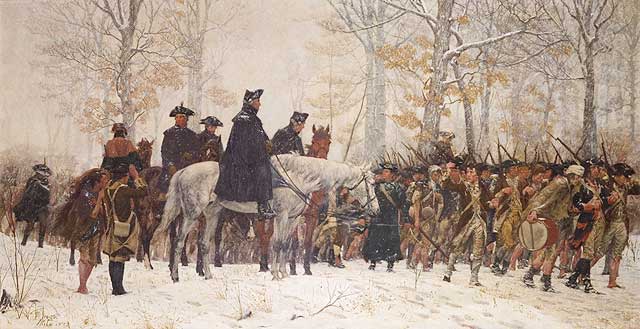
1777-1778—Winter at Valley Forge
Troops were stationed at Valley Forge during the winter between the wars. They had little food and no shelter in the begining.
Under-funded troops
Low morale
10,000+ troops
4,000 troops listed as “unfit for duty” due to poor supplies (boots, blankets, coats, etc.)
2,500 troops die of disease (typhus, typhoid fever, dysentery, pneumonia)
George Washington mentioned a lack of shoes so severe that the men's "marches might be tracked by the blood from their feet”
Local farmers would sell produce to Brits who could pay cash

1779—February, Vincennes

1780—August, Camden

—October, Kings Mountain
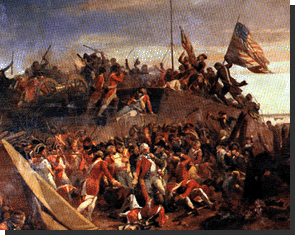
1781—October, Yorktown
Last Significant Battle of the War
British Gen. Cornwallis
American Gen. Washington (also “Mad” Anthony Wayne, Baron von Steuben)
French Gen. Rochambeau (also Marquis de Lafayette)
Essentially a French Naval victory
Last significant battle of the war

1783—Sept. 3, Treaty of Paris
Britain recognizes American independence
America gets all land from Atlantic coast to Miss. River, Great Lakes to Florida
Fishing rights to the Gulf of Saint Lawrence and off the coast of Newfoundland
America must pay debts to Britain
American congress would “earnestly recommend” all Loyalist property returned (States ignore this request)

Thursday, March 6, 2008

Plymouth Essay

The founding of English colonies in modern Massachusetts combined a strange mix of idealism and violence. Although the colonists did use violence, they had to use it to protect themselves and their colonies. Miles Standish contributed important protection to the early colonies by using violence. Benjamin Church also provided vital leadership to protect these colonies during King Phillip's war. But despite all the violence in these colonies they weren't based on violence alone. They were also based on religious freedom. That is what they came to America looking for.

Miles Standish contributed important protection to the early colonies by using violence. Miles Standish was a man who was brave and do anything to protect his colony. One way he did this was that he killed Wituwamat with his own knife. Standish organized a supper with Pecksuot and Witawumat. He knew that they would come because earlier Wituwatmat had "frightened" Standish. He said that he was going to kill him with this knife he had around his neck. But when they came for supper Standish took the knife from around Wituwamat's neck and stabbed him many times. He also was a man who would stop at nothing. When he thought that Squanto was dead he stormed into the camp where they thought he was. He had no second thoughts about bursting into the wigwam and screaming at the Indians. This proved that he would stop at nothing to protect and do what is best for his people. Also after Standish had killed Wituwamat he said that he would kill any other Indians he saw that day. He didn't want any Indians trying to kill him and his men because he just killed Wituwamat.

Benjamin Church provided vital leadership to protect the colonies during King Phillip's War. One way that he protects them is during the Indian ambush. There were 300 Indians and 20 of Church's men. He lead them all to safety and none of them died. This shows how good of a lead he is because he never gave up when the Indians started to try to surround them. He kept fighting to protect his men and win. Church was also a good leader because he captured Anawon and his people. Anawon was the last great chief of Phillip's tribe. Church wanted to take Anawon and his people prisoner with only 6 men on his side. He had a plan of attack and was prepared to die if Anawon do the job of taking in Anawon. He decided that he couldn't wait for backup because Anawon would have left by the time they got there. So he secured the Indians guns and approached them. 6 of Church's men took down 60 of Anawons men. This shows great planning and leadership. He also respected the people that he took prisoner or killed. He did not disrespect Anawon. He actually began to form a friendship with him. Church didn't want to mutilate him or kill him brutally. He was also upset when the government killed Anawon and put his head on a pole. This shows a good leader when he maintains respect for the people that he defeats.

Despite all of this violence,the colonies were also founded on religious idealism. Although the Pilgrims were violent to protect themselves they were also very religious. They were Puritan and had very strict beliefs. They were strong believers in public education. They also did nothing on the Sabbath. They were devoted to their beliefs and would not go against them. They also knew that they were a "City on a Hill." This means that whatever they did, they were being watched. They were going to be an example of whether the Pilgrims were going to succeed as a town or if they were going to fail. They also weren't looking for violence when they traveled here. They were looking for religious freedom. They didn't come to this new land to kill people or to try to take over. So the pilgrims didn't come looking for violence they were very strict religiously and they never looked for violence.

In conclusion, although Ben Church used leadership to protect the colonies and Miles Standish also protected the colonies. They may have used violence to protect themselves and their people but they never came looking for a fight. They just wanted to have religious freedom and be able to live as free people. It is important to know about all of this information because many people believe that America was founded on the pilgrims. It is important to know what they did as a colony and to know what they based their standards on.

Tuesday, March 4, 2008

Outline for Plymouth Essay

I. Introduction
A. The founding of English colonies in modern Massachusetts combined a strange mix of idealism and violence.

B. Miles Standish contributed important protection to the early colonies by using violence.

C. Benjamin Church provided vital leadership to protect the colonies during King Philip's War.

D. Despite all of this violence, the colonies were also founded on religious idealism.

E. It is important to understand the full history of these areas because this is what Americans generally consider to be our nation's beginning.

II. First Major Point
A. Miles Standish contributed important protection to the early colonies by using violence
B. Killed Wittawumac with his own knife
C. Went in the indians camp looking for Squanto in the middle of the night
D. Standish was planning an attack and was going to kill all the indians he saw in that day
E. Violence was used to protect the people of these colonies. They did not try to talk it out because that was unheard of during that time. Violence was all they knew. This is important because we have to know how they fought and protected themselves.

III. Second Major Point
A. Benjamin Church provided vital leadership to protect the colonies during King Phillip's War
B. Respected the people that he killed.
C. 20 indians defeated 300 indians without losing a man. Good leader
D. Church captured Anawon with only 6 men.
E. To show Church's great leadership there had to be violence. He didn't show great leadership in time of peace but in time of battles and killing. This is important because we see the leadership of this time and how they succeeded.

IV. Third Major Point
A. Despite all of this violence, the colonies were also founded on religious idealism.
B. The Pilgrims were Puritan and had strict religious beliefs.
C. "City on a hill"-everyone watches them
D. They came to find religious freedom so they weren't looking for violence
E. They didn't come looking for violence because they had strong religous beliefs but they had to fight to protect what they were building and trying to start.

V. Conclusion
A. The English colonies were mostly founded on violence. But they were also founded on idealism.
B. Miles Standish did use violence to help the colonies. To keep them safe.
C. Benjamin Church protected the colonies during King Phillip's war. He used violence and leadership to help them.
D. Violence wasn't the only thing that these colonies were founded on. They were also founded on religious idealism.
E. This is all important because many believe that America was started when the Pilgrim's came to America and began these colonies. To know the history and what happened is very important. We need to know how they started these colonies and what they were based on.

Thursday, February 14, 2008

Exam Quotes

Quote #1
They are gentle, loving, faithful, lacking in all guile and trickery. The words denoting lying, deceit, greed, envy, slander, and forgiveness have never been heard. They have no jealousy, no sense of possession.--John Smith (character)


Quote #2
We shall make a new start. A fresh beginning. Here the blessings of the earth are bestowed upon all. None need grow poor. Here there is good ground for all, and no cost but one's labor. We shall build a true common wealth, hard work and self reliance our virtues. We shall have no landlords to rack us with high rents or extort the fruit of our labor. --John Smith (character)

Tuesday, January 29, 2008

Wounded Knee Outline and Essay

Outline
I. Introduction:

A. Wounded Knee was a very violent conflict that was based on racism and misunderstanding.
B. The paragraph states that the men of the calvary were very unfair to the indians. They had no consideration for them.
C. The video that showed the trip to the monument for the indians showed that they were not very well respected. You can tell that because the monument was not very well taken care of and it was not very dignified.
D. In the video of what happened at the Battle of Wounded Knee it shows a cruelty to the indians showed by the U.S. Army.
E. These sources are important because they further your knowledge on the Battle of Wounded Knee

II. Body of Essay
A. Wounded Knee was one of the last battles that was ensued by racism and the differences of people.
B. The indians were treated like garbage. When the men began to disarm the indians they thought of it as a game. They were pointing guns at their heads just to scare them and the army thought that it was funny. (Paragraph on Blog)
C. When the monument was visited it showed that the indians died a painful and unjustified death and they were not even honored in the right way. (Home Video from trip to monument on blog)
D. The indians were treated so cruelly and brutally. The U.S. Army took no mercy on anyone. they were ruthless because they killed the woman with their babies as they were running. Then they told the children left to come out and they attacked them. (Video on blog giving details about Wounded Knee).

III. Conclusion
A. Wounded Knee was the last of the battles caused by the differences of the U.S Army, 7th Calvary, and Big Foot's people and the indians.
B. I learned that the indians were treated badly. They had it so bad back in those days and they were very brave for dealing with what they did.
C. I learned that the indians were not respected and they had to do a lot to have respect. Even after losing their lives in a very brutal battle they still did not have respect.
D. I learned that the women and children were not thought of as anything more than trash. It did not matter that the children were little and were helpless. The Army was ruthless and they would stop at nothing to get what they wanted.
E. The significance of this thesis is that it summarizes what this battle was caused by.

Wounded Knee Essay
The Wounded Knee Battle was the last of the battles caused by misunderstanding and racism. This battle was brutal and led to no more respect for the indians than what they had before. The U.S. Army was very cruel to the indians during this battle. The indians also gained no respect and they were not thought of as people. This battle was very brutal and was disrepectful to the indians.

The first thing that illustrates the fact that Wounded Knee was a brutal battle was the fact the soldiers beat on the indians. After the soldiers got drunk they decided to disarm the indians. Instead of just taking the weapons from the indians they terrorized them. They mocked them and beat them. They also held guns to their heads just to make them feel scared and to make the Army feel superior. This act alone shows that the soldiers thought of this as a game. They found it fun to take guns and scare these indians. While they were doing this a gun went off and the game was over and a fight began. This just illustrates what the indians went through during this process of simply disarming. The second thing that demostrates the lack of respect and racism was the monument that was erected in memory of the indians involved in this battle. This monument was not very clean. It didn't have a lot of dignity about it. This momunent was protected by fenced wire that you would use to make a kennel for a dog. This demonstrates the fact that they did not want to find something more suitable that would look more respectful. This monument is just and example of the fact that the indians endured so much pain and agony and they have no more respect than before the battle even occured. This shows that because they were indians they were not equal or as good as the Army. They were treated like they were different because of their heritage and the fact that they were indians. The final thing that proves this battle was brutal was the fact that the Army took mercy on no one. They were ruthless and they would stop at nothing to win this battle and prove their superiority. When the army was in the final part of the battle they told the remaining children to come out and they would be safe. These kids had just watched their parents being shot down and killed and now they are offered safety. You know they are going to come out. When they do they are attacked and killed. This shows the fact that the U.S. Army had no mercy on anyone. Be it a woman or a little innocent child. They were killed not because they were bad but because they were indian.

All of these points prove that the Wounded Knee Battle was a severe and painstaking battle. The indians endured more than anyone should ever have to. They were put through things that were cruel and inhumane. I learned to have more respect for the indians that went through this event. They were very brave and they had no reason to be killed. These indians who went through this agony are the real heros and should be remembered and honored.

Saturday, January 26, 2008

Book Portfolio #2

Hunger:
This book was very interesting. It was basically about the process of hunger. But also the history of hunger. In the book it spoke about The Great Hunger of Ireland. This is some history of hunger. This can also be known as the great potato famine. It lasted from 1845-1850. It all started when disease reached a crop of potatoes. This made the people start to worry. It then ruined another crop and another. People began to just eat the potato seeds and those who had none starved to death. This event was estimated to have cut the population in half. There was also the Chinese Famine. This lastest from 1958-1961. Basically what happened is the government forced the peasants from farming and into the mill work. Then the food industry took a hit because they didn't have many people to harvest the food. This book had a lot of good facts if you want to learn about the way hunger works and some of it's history.

Thursday, January 17, 2008

Final Draft of Local History

Corinna Union Academy


Brittany Sharpe
Mr. Viles
World Studies
January 7, 2007


Brittany Sharpe
Mr. Viles
World Studies
January 7, 2007
Corinna Union Academy

The Corinna Union Academy is an old but well known building in Corinna, Maine. Everyday people may drive by this building and not know the history behind it. This building has a story and you will be learning about what it how it was built and what is has grown to be.
The Corinna Union Academy was built in 1851. This began when a group of 70 people came together to build this high school. Before this Academy was built there were not many schools in the town or the towns surrounding Corinna. If this Academy was built it would be one of the largest in the town. The idea that these people had was to create a school that the town could benefit from down the road and would educate fine students. One year later the school was licensed by the State and seven years after that it opened. When the information on the courses and the school came out it read; the Academy contains two school rooms each one 32 feet. These were the drawing room and the recitation room. This means that there were two rooms in this old schoolhouse that were used for the education purpose. In 1931 the school was expanded. They built 2 more wings which had 4 classrooms. When this academy was built it was a 2 story white building with 17 windows and one door. It also included a bell tower. This is just what the town wanted. They had saved money for this Academy and now they had it. The style that this building was designed in is the Greek Revival style. These types of buildings were usually covered in clapboard and then were painted either white or gray. In this case the building was painted white. Also heavy trim is sometimes used and the corners of the building is accentuated by molding or carved wood. This type of building style was considered the first well liked and well used style of building.

Education then was much different than that of the world today. The first public school law was passed in 1647. This was started because the people of the towns wanted the children to have an education. This law had two purposes. The first was to stop Satan's desire to keep men from the knowledge of the scripture. The other was to prevent learning from being “buried” or lost with those who came before their children. From these laws one person was appointed to teach these children all of the basic learning skills, Reading, Writing and Arithmetic. The wages for these teachers were paid by the parents of the children or the masters of the children. This law was the basis for the higher education standards and ideas. Schools were not plenty in the 1800s. In 1800 Maine there were 161 incorporated towns within Maine. Within these 161 towns were 7 grammar schools. These 7 schools taught about 100 families children every year. This meant that the classrooms would be cramped and the teachers would have a hard time keeping their class under control. “Classes are so much smaller today then they were when I went to school. There were 15 or 16 people in a class and that was it.” Said Fran Kirk of class sizes today. In 1820 Maine had 236 incorporated towns and in those towns were 25 academies. During this time public taxation became the primary way of paying for these schools. Education now is much more different. When I asked Fran Kirk, a former student of Corinna Union Academy, how education had changed she said “Education has changed because the standards are much higher. Today there are more tests and more pressure to exceed.” Today there are 177 districts within the state of Maine with too many schools to count. Today we have programs such as No Child Left Behind so that children get the education that they need. In those times they did not have these laws. This law ensures that every child gets a fair education that they understand and that they have a chance to do the best they can. In the 1850s there were no laws like this. Every child had a chance to learn but they did not have the tools or standards that we have today.

The Corinna Union Academy is now known as the Corinna Union Academy Historical Society. It was shut down as a high school in 1968 when Nokomis Regional High School was built in Newport, Maine. After this it became a junior high. Frank Kirk says “I went to that school from 1953 to 1955 and I love it. The school was great and the teachers were good also.” It then was condemned as unsafe to for a junior high in 1998 and was shut down. It then caught on fire in 2000 in the upstairs and they had to replace it. Then it caught fire again in the tower due to an electric problem. The damage was minimal and was fixed. In 2004 it was re-opened as a historical society. In the summer months it is open and available for tours. It holds antiques such as old high school year books, items that were used in the farming process. It also holds historical pictures and artifacts of the town. There are still meetings occasionally held there today. This building represents what the town has been through and how it changed. This school was in the town and it grew with the town. It is like a symbol of growth.

I hope that you learned a lot about this Academy and that next time you drive by you think what it has been through. It has been through fire and survived. It shows how the education has changed. It shows how much the times have changed from the architecture to the teaching styles. It also demonstrates how buildings can be used for many purposes. So next time you drive by and think what an old building, instead think what an amazing building.


Sources:
“Corinna Union Academy.” Cattail Press. 17, November 2006 <http://www.cattailpress.com/Features/May01/CUApics.htm>

“A brief history of Corinna , Maine.” Donna & Patrick Cator 2003-2006
http://catorfamily.com/genealogy/titcombincorinnamaine3.html

Kirk, Fran. Personal Interview. 20, December 2007

Maine.gov. 2006
http://www.maine.gov/search?q=No+Child+Left+Behind+program&as_sitesearch=http%3A%2F%2Fwww.maine.gov%2F&site=test_collection&output=xml_no_dtd&client=test_collection&proxystylesheet=test_collection


Outline:

I. Corinna Union Academy
A. You always drive by building and think nothing of it.
B. You need to know the history so you can appreciate it

II. The School
A. Academy was built in 1851. 70 people came together
1. Academy would be only one around
2. Later the school was licensed by the state
3. 7 years later it re opened
B. Two Schoolrooms in the schoolhouse
1. How big were the schoolrooms
2. What it looked like on the outside
3. What design of building it was
III. Education
A. Education then
1. Law of Education
2. Way of teaching
3. Towns within the schools
B. Education now
1. How many districts
2. Differences in sizes of schools
3. Programs we have today
IV. What the CUA is today
A. Now it is a historical society
1. Shut down as a high school in 1968
2. Then closed as junior high in 1998
3. Caught fire in 2000
B. What has happened to it
1. Caught Fire again in tower
2. Opened in 2004 again
3. What it holds today
V. Conclusion
A. You need to know the history so you can appreciate it
B. Built in 1851 closed in 1968. Re opened as a historical society
C. Review history of the CUA and propose that you think about the building and history when you pass by it.

Wednesday, January 16, 2008

Final Exam Essay


The opportunity for the Nazi's to come into power is simple. The leadership during the 1930's was not very good. So if someone came along offering people a reason for the terrible times and things that were happening they would want to listen. People were looking for answers as to why they were suffering and they were willing to do anything to make their life better. They wanted someone to just communicate with them and give them any hope or any good news. Germany was in a state of suffering. So if someone came along and offered them a new life and a better way to live it, the people would take that. That is why Germany was in an easy state for someone like Adolf Hitler to take over.


When Hitler first came forward telling people that the reason that the world was like this is because of the Jews people were spectacle. But when people are in desperate need for something else and someone comes along telling them that these Jewish people are the cause then they may start to believe it if they are told it enough. So Hitler began his journey to start a group called the Nazi's and start to persecute the Jewish people. Hitler began telling people in daily speeches that the Jewish were the reason that the Germans didn't have enough food or that the war was going on. So when the Germans were at their weakest Hitler began to form his group. He told people that he could help them get out of debt and get them money and a new life. All they had to do was join this group and end the war.


The German people did not rise against Hitler during the Holocaust period is because things were not bad for people who were not Jewish. They were not being persecuted or dying because Hitler was doing that to the Jewish. People were also afraid to rise up against him because of what he was doing to the Jews. If they tried to rise up against him he might do the same to them. Plus people figured that what he said was true. With the Jews in concentration camps there seems to be less debt and poverty and less problems. Even though this might not have been true and the Germans could see that Hitler told people this enough that they started to believe what he said was true. So instead of fighting back they let him be in control and handle a "problem" that was supposedly blamed on a group of innocent people. So this is why they did not rise up against Hitler because by the time he was done talking the German people weren't sure what he was saying was a lie because he had said it so much. He had convinced them that what he was saying was true.